
Interlock repair
Pavers rarely fail. What is under them does.
Concrete pavers outlast the people who install them. When an interlock driveway looks bad it is almost never the pavers — it is lost joint sand, a failed edge restraint, or a base that has settled. All three are fixable, and because the pavers get reused there is no colour mismatch afterwards.
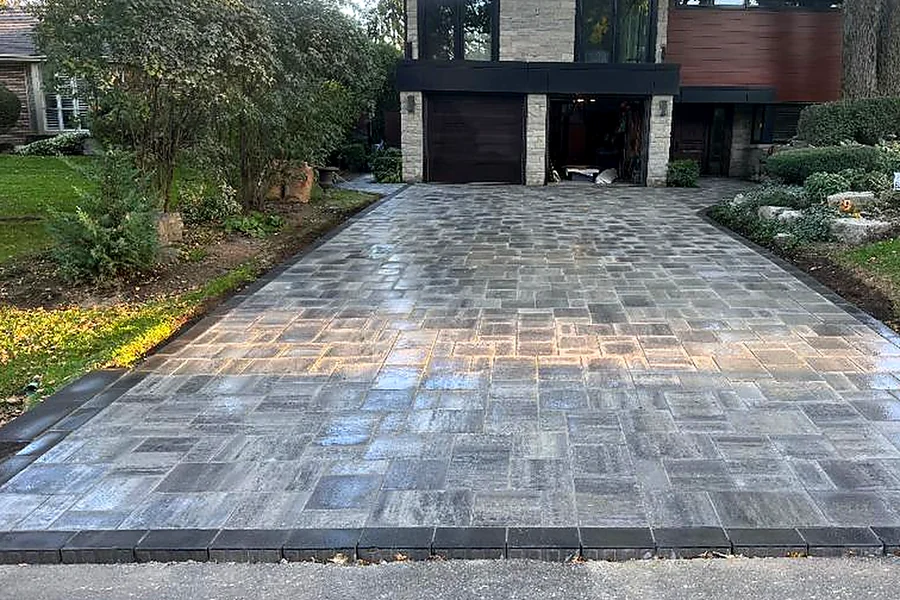
The three things that go wrong
Lost joint sand. Regular masonry sand washes out with rain and freeze-thaw. Once joints are empty the pavers have room to move, the pattern opens, and weeds establish. The fix is re-jointing with polymeric sand, which sets when wetted.
Failed or missing edge restraint. Without a concrete haunch or heavy-duty edging, the field spreads outward a few millimetres a season. By year five the border row has migrated and gaps appear. The fix is excavating the perimeter and installing proper restraint.
Settled base. Shows as a dish, lipping between pavers, or a low area that holds water. The fix is lifting the affected pavers, correcting and recompacting the base, and re-laying them.
What a re-levelling actually involves
The affected pavers are lifted by hand and stacked in order. The bedding layer is removed and the granular base beneath is inspected — if it has settled it gets recompacted, and if material has migrated out it gets replaced.
New bedding sand is screeded to level, the same pavers go back in the same pattern, and the whole area is compacted with a plate on a protective pad and re-jointed with polymeric sand.
Because your original pavers are reused, the repaired area matches the rest exactly. That is the structural advantage interlock has over every poured surface — there is no patch, and no seam.
Efflorescence is not damage
White powdery staining on pavers is efflorescence: mineral salts working out of the concrete as it cures. It appears in the first year or two and weathers off on its own.
It is not a defect, it is not a base problem, and nobody should be selling you a repair for it. If it bothers you, an efflorescence cleaner accelerates the process.
Pricing
Ranges we quote across the GTA in 2026. Your number depends on area, access, disposal and what has to come out first — confirmed on site.
| Work | Price | Typical project |
|---|---|---|
| Paver re-levelling | $6 – $12 / sq ft | Lift, re-base, re-lay and re-joint |
| Re-jointing only | Quoted | Polymeric sand where the base is sound |
| Edge restraint | Quoted | Per linear foot of perimeter |
| Full rebuild | $16 – $25 / sq ft | Where the base has failed across most of the area |
Ranges are for planning, not a quote. Get your exact number →
Questions
Can individual pavers be replaced?
Yes — that is the main advantage of interlock. Keep leftover pavers from your original job for this, because dye lots change between production runs and an exact match years later is not guaranteed.
How much does interlock repair cost?
Re-levelling runs $6 to $12 per square foot depending on how much base correction is needed. Re-jointing alone is considerably less.
Why are weeds growing between my pavers?
Almost always because the joint sand has washed out. Airborne seed germinates in the debris that fills the empty joint. Re-jointing with polymeric sand solves it.
My pavers are lipping at the edges. What causes that?
Uneven settlement of the bedding or base under them, usually from water. Lifting and re-basing that area is the fix; grinding the lips is not.
Is repair worth it or should I replace?
Repair, in almost every case. Pavers are the expensive part and they are reusable. Full replacement only makes sense when the base has failed across most of the area.
Related
Keep reading
Free estimate
We measure, check the base, and quote in writing.
No phone estimates. Square footage, base depth and a fixed price within 48 hours.
Request my estimate