
Re-jointing
Empty joints are how interlock starts to fail.
The sand between your pavers is structural. It is what transfers load from one paver to the next and turns a field of separate units into a single interlocking surface. When it washes out, the surface stops behaving as one thing.
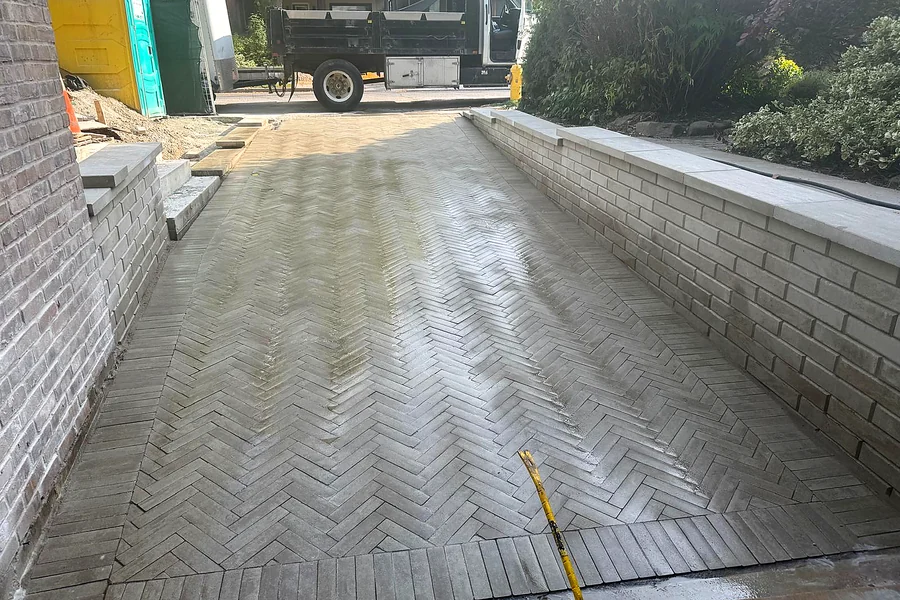
What the joints actually do
Interlock works because each paver is braced by the ones around it. Load applied to one is distributed sideways through the joints into its neighbours, which is why a herringbone bond carries vehicles that would rut a running bond.
That transfer only happens if the joints are full. An empty joint means the paver is free to rock and settle independently, and once one moves the ones around it lose their bracing too.
So joint sand is not a finish. It is part of the structure.
Polymeric versus regular sand
Regular masonry sand is loose aggregate. Rain washes it out, wind lifts it, and a pressure washer removes it in seconds. In the GTA it is largely gone from the top of the joint within two or three seasons.
Polymeric sand contains a binder that activates when wetted and sets into a firm, slightly flexible fill. It stays put through rain and freeze-thaw, resists weed germination, and still allows the small amount of movement pavers need.
The cost difference on a driveway is modest. The difference in how long the surface stays tight is years.
How it is done
Old joint material is removed to a depth of at least 25 mm — usually with a blower and a joint rake, sometimes with a pressure washer where the joints are badly contaminated. This is the step that decides the result; sand poured on top of dirt does not bond.
The surface must be completely dry before the new sand goes in. It is swept into the joints, vibrated in with a plate compactor on a protective pad so it settles fully, topped up, and swept clean.
Then a controlled watering in stages to activate the binder without washing it out, and 24 hours to cure. Rain during that window is the one thing that ruins the job, which is why we watch the forecast rather than the calendar.
What it will not fix
Re-jointing tightens a surface whose base is sound. It does not correct a settled area, a dish that holds water, or pavers that are lipping because the bedding underneath has moved.
If the base is the problem, sand goes back into a joint that will open again. Those areas get lifted and re-based first.
Pricing
Ranges we quote across the GTA in 2026. Your number depends on area, access, disposal and what has to come out first — confirmed on site.
| Work | Price | Typical project |
|---|---|---|
| Re-jointing | Quoted | By area and how contaminated the joints are |
| Joint removal | Included | Old material cleared to 25 mm minimum |
| Re-levelling first | $6 – $12 / sq ft | Where the base has settled under an area |
| Paver sealing | Quoted | Optional, after jointing has cured |
Ranges are for planning, not a quote. Get your exact number →
Questions
How often does polymeric sand need redoing?
Five to ten years on a driveway, longer on a patio. It degrades from UV at the very top of the joint and from pressure washing, which is the fastest way to destroy it.
Can I pressure wash my interlock?
Carefully and on a wide fan at low pressure. A narrow high-pressure jet strips polymeric sand out of the joints in seconds and creates the exact problem you were cleaning to avoid.
Will it stop weeds completely?
Almost. Sealed joints prevent germination from below; what appears is airborne seed rooting in surface debris, which sweeps out easily.
Can it be done in the fall?
Yes, provided daytime temperatures stay above about 5°C and there is a dry 24-hour window to cure. Late fall in the GTA gets tight for that.
What if some joints are much wider than others?
Polymeric sand has a maximum joint width it can bridge. Very wide or irregular joints may need a different product or the pavers reset — we assess before quoting.
Related
Keep reading
Free estimate
We measure, check the base, and quote in writing.
No phone estimates. Square footage, base depth and a fixed price within 48 hours.
Request my estimate