
Permeable paving
The surface the City increasingly wants you to build.
Permeable pavers let rainwater pass through the joints into an open-graded stone reservoir underneath, where it soaks into the ground instead of running into the storm sewer. In Toronto it has moved from an environmental option to a requirement on a lot of new and expanded driveways.
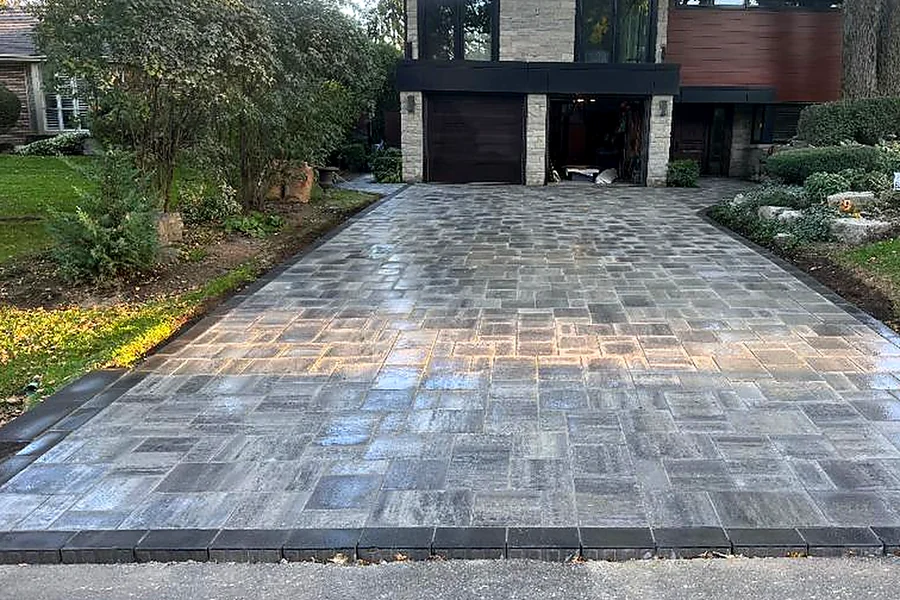
How a permeable system differs underneath
A standard interlock driveway sits on compacted granular that is designed to shed water sideways. A permeable one sits on clear, open-graded stone with deliberate void space — typically 30 to 40 percent air — designed to hold water and release it slowly into the soil below.
The joints are wider and filled with small clear chip rather than polymeric sand, so water goes down instead of running off. The base is deeper, usually 400 mm or more, because it is a reservoir as well as a structure.
That is why it costs more. You are not buying a different paver; you are buying a stormwater system with a driveway on top.
The Toronto rule, in plain terms
The City requires stormwater retention for new hard surfaces above roughly 50 square metres. Replacing an existing driveway in its current footprint generally does not trigger it. Building a new driveway, widening an existing one, or converting soft landscaping to hard surface generally does.
Penalties for non-compliance are significant, and the requirement is enforced at the permit stage — which means the problem surfaces when you apply, not after you have paved.
There are also municipal rebates that offset part of the cost of subsurface drainage work. We confirm what your property qualifies for during the site visit and prepare the filing where one is needed.
Maintenance, which is real but manageable
The one thing that kills a permeable system is clogged joints. Fine sediment — from soil washing in off a garden bed, or from tracking in on tires — gradually fills the void space and the surface stops infiltrating.
The maintenance is straightforward: keep adjacent soil from washing across it, sweep or vacuum the surface once or twice a year, and top up the joint chip when it drops. Done routinely it stays functional indefinitely. Ignored for a decade it needs the joints vacuumed out and refilled.
Do not sand a permeable driveway in winter. Sand is precisely the material that clogs it.
Pricing
Ranges we actually quote across the GTA in 2026. Your number depends on square footage, access, disposal and what has to come out first — all confirmed on site.
| Work | Price | Typical project |
|---|---|---|
| Permeable interlock driveway | $21 – $30 / sq ft | Rebate-eligible; deeper base than standard interlock |
| Permeable border only | Quoted | A compliant strip within a conventional surface |
| Standard interlock | $16 – $25 / sq ft | Where permeable is not required |
| Joint maintenance | Quoted | Annual or biannual vacuum and top-up |
Ranges are for planning, not a quote. Get your exact number →
Questions
Do I need permeable pavers for my driveway?
If you are replacing an existing driveway in the same footprint, usually no. If you are building new, widening, or converting lawn to hard surface above roughly 50 square metres in Toronto, usually yes. Other GTA municipalities have their own thresholds and we confirm yours before quoting.
Do permeable pavers work in Toronto winters?
Yes, and often better than solid surfaces. Because water drains through rather than sitting on the surface, there is less sheet ice. The reservoir below sits under the frost-susceptible zone.
Can I plough and salt them?
Plough normally with a rubber-edged blade. Salt is acceptable; sand is not, because it clogs the joints that make the system work.
How much of the cost does the rebate cover?
It varies by program and by what is installed. It is meaningful but not the whole difference, and it is worth applying for on any project that qualifies. We prepare the filing as part of the job.
Will it look different from a normal paver driveway?
Slightly. The joints are wider and filled with small stone instead of sand, which is visible up close and largely invisible from the street. The paver range is narrower than conventional, but the finished result reads the same.
Related
Keep reading
Free estimate
We measure, check the base, and quote in writing.
No phone estimates and no pressure. Square footage, base depth and a fixed price within 48 hours.
Request my estimate