
Interlocking
Interlock driveways built to stay flat.
Concrete pavers laid on a properly compacted base, with polymeric sand joints and edge restraint around every perimeter. The pattern you choose is the part you see. The base and the border are the parts that decide how long it stays looking that way.
Why interlock costs more than asphalt
Asphalt arrives hot and gets machine-laid in two passes. Interlock is placed piece by piece, cut around every curve and obstacle, then edged, jointed and compacted. The material costs more, but labour is where the real difference sits — a driveway that takes two days in asphalt takes five to eight in pavers.
What you get for that is a surface that can be repaired without a seam. A cracked asphalt driveway gets patched, and the patch is visible forever. A damaged paver gets lifted out and a new one dropped in. Ten years later nobody can tell where it happened.
Patterns, and what they actually do
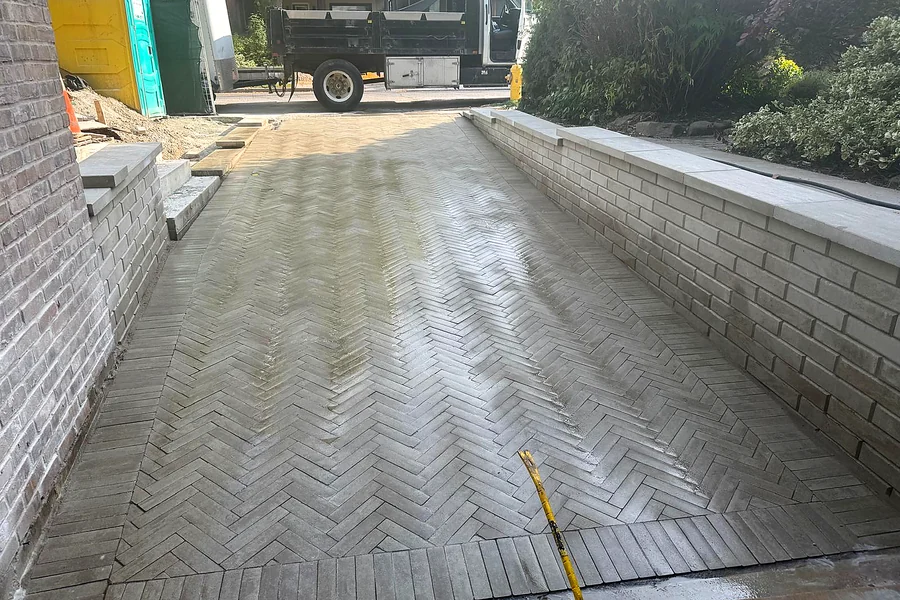
Herringbone is the strongest bond for anything a car drives on. The 45° or 90° interlock spreads load sideways across neighbouring pavers instead of pushing straight down, which is why it resists the rutting you see in running-bond driveways after a few years. It costs more to lay because of the cutting at the edges, and it is worth it.
Running bond and stack bond suit patios and walkways where the load is foot traffic. On a driveway they move.
Random ashlar mixes several paver sizes into an irregular layout. It reads as natural stone and hides minor colour variation between pallets, which is useful on larger areas.
Whatever the field pattern, the perimeter gets a soldier course — a border row running the long way around the edge. It frames the work and, more importantly, it is what the edge restraint locks against.
The two things that fail first
Joints. Regular masonry sand washes out with the first heavy rain and the first freeze-thaw cycle. Once the joints are empty, pavers have room to shift, the pattern opens, and weeds arrive. We use polymeric sand, which sets when wetted and holds the joint closed.
Edges. An interlock driveway with no restraint spreads outward a few millimetres every season. Nobody notices in year one. By year five the border row has migrated into the lawn and the field has gaps. Every perimeter we lay gets a concrete haunch or heavy-duty edging, buried below grade so you never see it.
Permeable pavers and the Toronto rule
The City of Toronto requires stormwater retention for new hard surfaces above roughly 50 square metres. In practice that usually means permeable pavers — wider joints filled with clear stone, over a deeper open-graded base that holds water and lets it infiltrate rather than run into the storm sewer.
Permeable systems cost more, around $21 to $30 per square foot, because the base is deeper and the aggregate is washed. They are also the only route to approval on many new or widened driveways, and there are municipal rebates that offset part of the cost. We confirm which rules apply to your property during the site visit.
Pricing
Ranges we actually quote across the GTA in 2026. Your number depends on square footage, access, disposal and what has to come out first — all confirmed on site.
| Work | Price | Typical project |
|---|---|---|
| Interlock driveway | $16 – $25 | $8,500 – $17,500 for a typical two-car driveway |
| Permeable interlock | $21 – $30 | Required by the City for many new or expanded driveways |
| Natural stone | Quoted | Flagstone and granite priced by material and cut |
| Repair & re-levelling | $6 – $12 | Lifting, re-basing and re-setting an existing area |
Ranges are for planning, not a quote. Get your exact number →
Questions
How long does an interlock driveway last?
Twenty-five years and beyond when the base is right and the joints are maintained. Pavers themselves do not wear out in a residential lifetime — what fails is the base under them or the sand between them, and both are things you control at the quoting stage.
Do pavers get slippery in winter?
No more than any other surface. Textured and tumbled finishes give more grip than smooth ones. Pavers also handle plough and shovel work better than stamped concrete, which chips at the pattern lines.
Can I plough or salt an interlock driveway?
Plough with a rubber-edged blade or a raised shoe so the steel does not catch a paver lip. Salt is fine on concrete pavers, though rock salt is harsh on any hardscape over time — sand and a lighter de-icer are gentler.
What if a paver cracks?
It gets lifted and replaced individually. Keep a small stock of leftover pavers from your job for exactly this; dye lots change between production runs and a match five years later is not guaranteed.
How much does an interlock driveway cost in the GTA?
Between $16 and $25 per square foot installed, which puts a typical 500 to 700 sq ft two-car driveway in the $8,500 to $17,500 range. Removal of an existing concrete surface, restricted access and permeable requirements all move the number.
Related
Keep reading
Free estimate
We measure, check the base, and quote in writing.
No phone estimates and no pressure. Square footage, base depth and a fixed price within 48 hours.
Request my estimate