
Comparison
Asphalt or interlock? It depends on three things.
How long you are staying, how much you want to spend now, and how you feel about repairs being visible. Both surfaces survive Toronto winters when the base is right, and both fail fast when it is not. Everything else is trade-offs.
Cost, honestly
Asphalt is $4 to $7 per square foot installed. Interlock is $16 to $25. On a 600 sq ft driveway that is roughly $2,400–4,200 against $9,600–15,000.
The gap is labour, not material. Asphalt arrives hot and is machine-laid in two passes. Interlock is placed piece by piece, cut around every curve, edged and jointed. Two days versus five to eight.
Lifespan and how they age
Asphalt on a proper base lasts twenty to twenty-five years with sealing every three to four. It ages by fading from black to grey and developing surface cracks from about year seven.
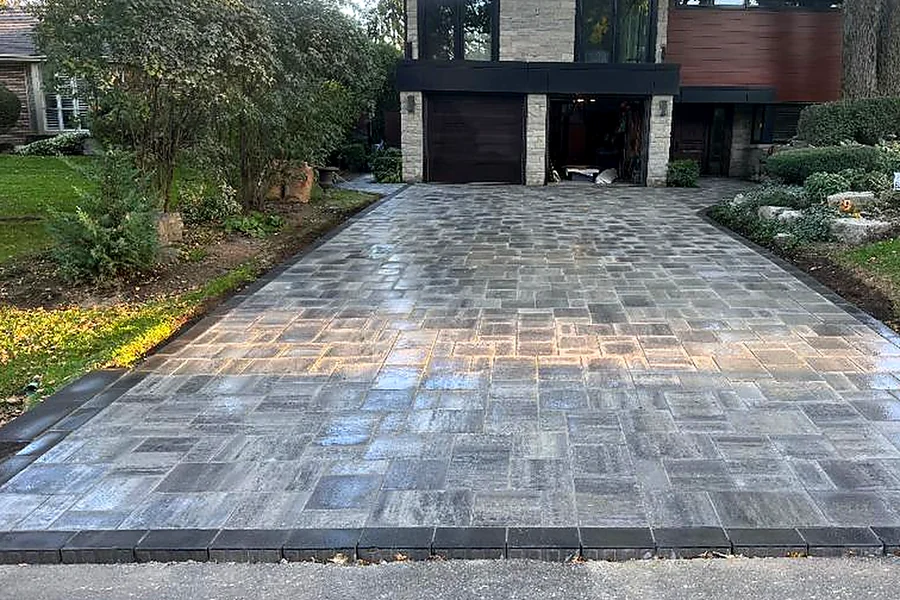
Interlock on a proper base lasts twenty-five years and beyond. The pavers themselves do not wear out in a residential lifetime — what needs maintenance is the joint sand every five to ten years.
Both figures collapse to three to five years on a shallow or uncompacted base. The base decides more than the surface does.
Repairs — the real difference
This is where interlock earns its price. A damaged paver is lifted out and a new one dropped in. A settled area is lifted, re-based and re-laid using your original pavers. Ten years later nobody can tell where it happened.
Asphalt repairs are always visible. A patch is a different age and a different colour, with a seam around it, permanently.
If you plan to be in the house for twenty years, that difference compounds.
Winter performance
Neither is meaningfully more slippery than the other; textured pavers arguably give more grip than smooth asphalt.
Ploughing: asphalt takes any blade. Interlock wants a rubber-edged blade or a raised shoe so steel does not catch a paver lip.
Salt: fine on both, harsh on both over decades. Sand is gentler — except on permeable interlock, where sand clogs the joints that make the system work.
Snow melts faster on asphalt because it is darker and absorbs more heat. A genuine small advantage in a GTA winter.
Which to choose
Choose asphalt if: budget is the deciding factor, you may move within ten years, the driveway is long or awkwardly shaped so interlock labour climbs steeply, or you simply want the job done in two days.
Choose interlock if: you are staying long term, curb appeal and resale matter, you want repairs to be invisible, or your municipality requires permeable paving anyway — in which case interlock is the route to compliance.
The rule that matters more than either: asphalt on a properly built base outperforms interlock on a bad one, every time. If the budget only stretches to one of good base or premium surface, choose the base.
Pricing
Ranges we quote across the GTA in 2026. Your number depends on area, access, disposal and what has to come out first — confirmed on site.
| Work | Price | Typical project |
|---|---|---|
| Residential asphalt | $4 – $7 / sq ft | $2,400 – $4,600 for a two-car driveway |
| Interlock driveway | $16 – $25 / sq ft | $8,500 – $17,500 |
| Asphalt with paver border | $4 – $7 / sq ft + border | The middle option most people end up choosing |
| Permeable interlock | $21 – $30 / sq ft | Where the City requires retention |
Ranges are for planning, not a quote. Get your exact number →
Questions
Which lasts longer in Toronto?
Interlock, marginally — twenty-five years and beyond against twenty to twenty-five for asphalt. But both depend far more on base construction than on the surface material.
Which adds more to resale value?
Interlock, generally. It reads as a premium finish from the street, and buyers price curb appeal even when they cannot articulate why.
Is there a middle option?
Yes, and it is the one most people choose once they see it: asphalt with a paver border course. It costs a fraction of full interlock, frames the driveway, and gives a cleaner edge that resists crumbling.
Which is better for a steep driveway?
Asphalt, usually. It is a continuous surface with no joints to shift, and it takes ploughing on a slope better.
Can I convert asphalt to interlock later?
Yes. The existing asphalt is removed and the base is inspected and corrected as needed. You are not locked in — you are just paying for excavation twice.
Related
Keep reading
Free estimate
We measure, check the base, and quote in writing.
No phone estimates. Square footage, base depth and a fixed price within 48 hours.
Request my estimate