
Problem
Sinking near the garage is a backfill problem.
If the low spot in your driveway is the last couple of metres before the garage door, the cause is almost certainly not your driveway. It is the trench that was dug when the house was built and never properly compacted afterwards.
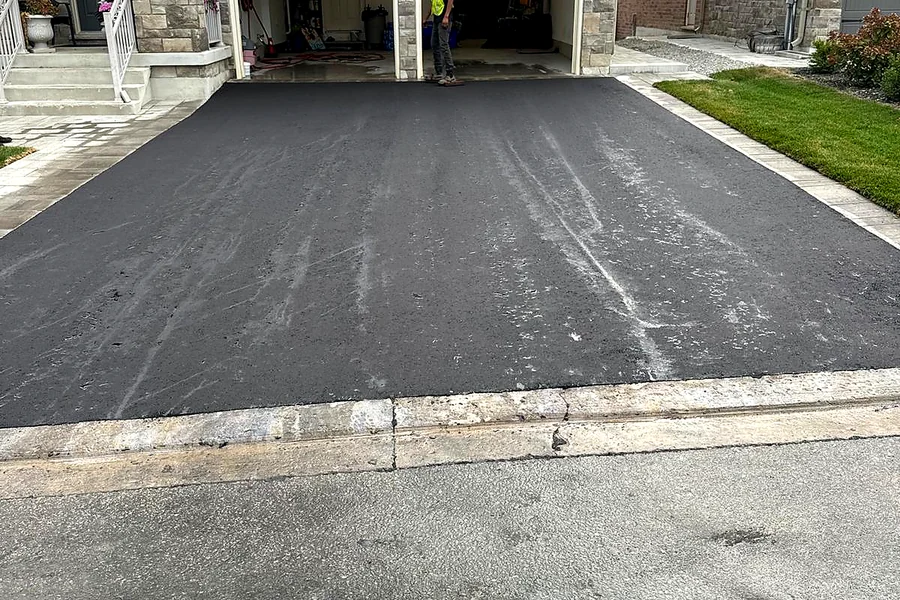
What is underneath
Foundation excavation is always wider than the wall itself so crews can work and waterproof from outside. When the work is done, that gap is filled back in.
In residential construction that backfill is frequently the same soil that came out, pushed back in bulk rather than placed in compacted lifts. It has void space that undisturbed soil does not, and it consolidates slowly for years or decades under its own weight and under vehicle loads.
Everything sitting on it goes down with it. The rest of the driveway, on undisturbed ground, stays put — which is why the failure is always a defined strip rather than the whole surface.
Why filling it does not work
The obvious fix is to add material to the low spot and pave over it. It looks correct on the day.
But the settlement is ongoing and the cause is below. The new material sits on the same consolidating backfill and follows it down. Most patched aprons are noticeably dished again within one to three years.
Mudjacking or foam injection can work under concrete slabs. Under an asphalt driveway on settling backfill, they are usually a temporary measure.
The repair that holds
Cut out the affected section square, back to sound material. Remove or properly compact the settled fill in lifts of 200 mm or less — this is the entire job, and it is what a cheap quote leaves out.
Then geotextile, new granular base compacted in two lifts, and asphalt in base and surface course, tied into the existing driveway with a saw-cut joint.
Set the finished level flush to the garage threshold with fall away from the door, so water leaves rather than pooling at the entrance.
The related problem: water at the door
A dished apron collects water directly against the garage. In summer that tracks under the door; in winter it becomes ice at the exact spot people step out of a vehicle.
Correcting the grade is part of the repair, not an extra. Where the yard cannot take the runoff, a small drain at the low point handles it.
Pricing
Ranges we quote across the GTA in 2026. Your number depends on area, access, disposal and what has to come out first — confirmed on site.
| Work | Price | Typical project |
|---|---|---|
| Apron section rebuild | Quoted | By area and depth of settled fill |
| Full driveway rebuild | $4 – $7 / sq ft | Often better value when the rest is also aging |
| Drain at the threshold | Quoted | Where grade alone cannot move the water |
Ranges are for planning, not a quote. Get your exact number →
Questions
Can it be lifted rather than rebuilt?
Foam or slurry lifting works well under concrete. Under asphalt on active backfill it is generally temporary, because the fill continues to consolidate under whatever is injected.
Will it keep sinking forever?
Backfill consolidation slows over time but can continue for decades. The only way to stop it is to remove or properly compact the fill itself.
How much of the driveway needs to come out?
Usually only the affected strip plus a margin into sound material. We probe to find where the settled fill ends before cutting.
Is this covered by a builder warranty?
On newer homes it sometimes is, depending on age and the warranty terms. Worth checking before paying for the repair yourself.
Could it be a broken pipe rather than backfill?
Occasionally. A leaking service line washing out fines produces a similar dish. If the settlement is recent, sudden or accelerating, that gets ruled out first.
Related
Keep reading
Free estimate
We measure, check the base, and quote in writing.
No phone estimates. Square footage, base depth and a fixed price within 48 hours.
Request my estimate