
Problem
That white haze on your new pavers is normal.
It appears a few weeks or months after installation, it looks like the pavers are staining or fading, and it is one of the most common calls contractors get from worried homeowners. It is also not a defect, not damage, and not anybody's fault.
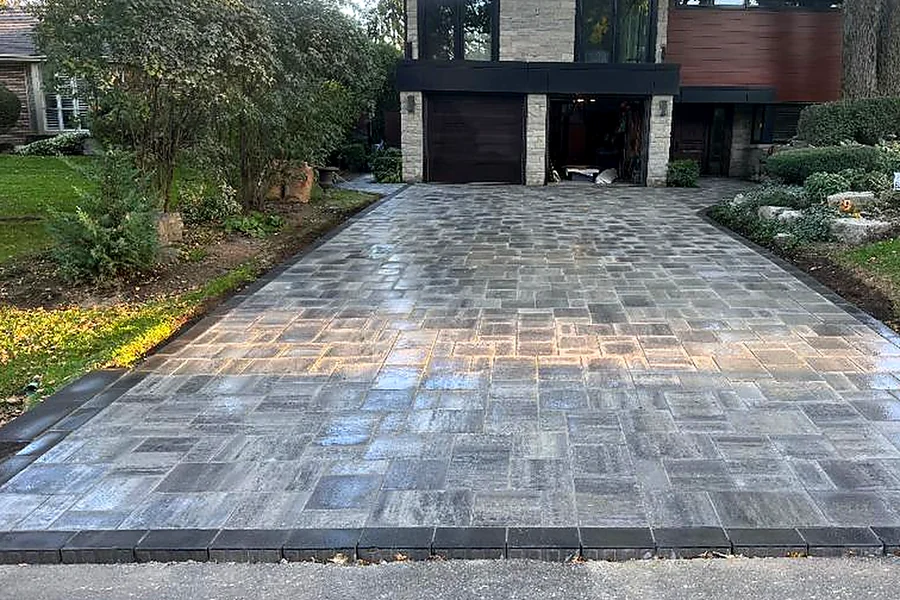
What it is
Concrete pavers contain naturally occurring mineral salts. As the concrete continues to cure, moisture moves through it and carries some of those salts to the surface.
The water evaporates. The salts stay behind as a fine white deposit — usually a haze, sometimes patchy, sometimes concentrated at edges.
It is called efflorescence, it happens on virtually all concrete products, and it says nothing about the quality of the paver, the installation or the base.
Why it varies across the surface
Because moisture movement varies. Pavers over a slightly damper part of the base, or in shade where evaporation is slower, produce more visible deposit.
That is why it often appears in patches rather than evenly, which is exactly what makes people think it is a stain or a defect in specific pavers.
What to do
Nothing, ideally. It weathers off over one to two seasons as rain gradually dissolves and removes the deposit. Most of it is gone by the second summer.
If you want it gone sooner, an efflorescence cleaner formulated for concrete pavers accelerates it. Follow the product directions and test an inconspicuous area first.
Do not use household acids or a strong pressure wash. Acid can etch the paver surface and change its colour permanently, and high pressure strips the joint sand.
Do not seal over it. Sealing traps the deposit under the sealer, where it is permanent and considerably more visible.
When white marks are not efflorescence
Efflorescence is a fine powder that dissolves and reduces over time. If a white mark is hard, raised, growing, or appears years after installation rather than in the first season, it may be something else — mortar residue, mineral deposit from runoff, or salt damage.
Those are worth looking at. The first-year haze is not.
Questions
How long does efflorescence last?
Typically one to two seasons. It fades gradually rather than disappearing at once.
Can it be prevented?
Not reliably. It depends on the paver, the moisture in the base and the weather during curing.
Should I seal my pavers to stop it?
Not while it is present — sealing traps it. If you want to seal, wait until the efflorescence has weathered off.
Related
Keep reading
Free estimate
Questions about your own driveway?
We measure on site, probe the base and quote in writing within 48 hours.
Request my estimate