
Comparison
Three surfaces, one climate that punishes two of them.
Asphalt, poured concrete and interlock all get used for driveways across the GTA. They behave very differently through freeze-thaw, and the one people assume is the most durable is arguably the least suited to this climate.
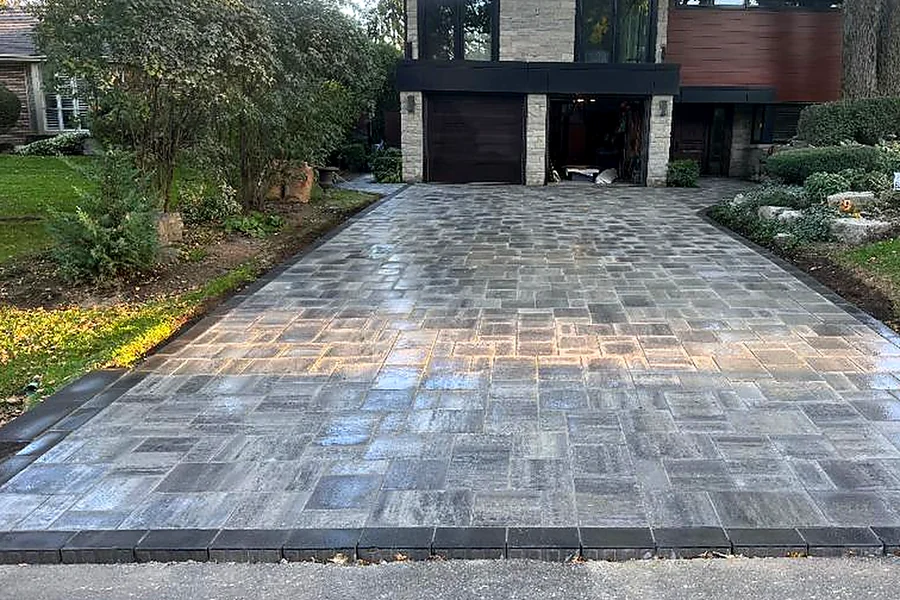
Poured concrete — the one to think hardest about
Concrete is strong in compression and weak in tension, and it is a single continuous slab. When the ground beneath it moves — which on GTA clay it does, every winter — the slab cannot flex. It cracks.
Control joints are cut to decide where those cracks happen, which manages appearance but does not prevent movement.
Concrete is also the most vulnerable of the three to de-icing salt, which causes surface scaling that cannot be repaired invisibly.
And repairs are effectively impossible to blend. A patched concrete driveway looks patched permanently. It is expensive, it is beautiful when new, and in this climate it carries the most risk.
Asphalt — flexible and forgiving
Asphalt is a flexible pavement. It accommodates small amounts of ground movement without cracking, which suits clay subgrade and freeze-thaw well.
It is the cheapest of the three at $4 to $7 per square foot, it installs in one to three days, and it is easy and inexpensive to maintain.
The trade-offs: it needs sealing every three to four years, it fades from black to grey, and every repair leaves a visible seam.
Interlock — many small units instead of one big one
Interlock handles ground movement best of the three because it is not a continuous surface. Individual pavers can move fractionally without anything cracking, and the joints absorb it.
It resists salt scaling far better than poured concrete, and repairs are genuinely invisible because the original pavers get reused.
The trade-offs: it costs $16 to $25 per square foot, it takes five to eight days, and joint sand needs redoing every five to ten years.
The summary
Asphalt if budget matters most, or you may move within a decade.
Interlock if you are staying long term, want invisible repairs, or need permeable paving for compliance.
Concrete if you specifically want that look and accept that it will crack somewhere and that repairs will be visible.
And the rule that outranks all three: any of them on a properly built base outperforms any of them on a bad one.
Questions
Is concrete more durable than asphalt?
In pure compressive strength, yes. In a freeze-thaw climate on clay soil, its rigidity works against it and its salt vulnerability is worse.
Which is cheapest to maintain?
Interlock over a long horizon — re-jointing every five to ten years and no resealing. Asphalt is cheaper per intervention but needs them more often.
Can I put interlock over an existing concrete driveway?
Sometimes, if the slab is sound and level and the resulting height works at the garage and street. More often the concrete comes out.
Related
Keep reading
Free estimate
Questions about your own driveway?
We measure on site, probe the base and quote in writing within 48 hours.
Request my estimate