
Problem
What salt actually does to your driveway.
Salt does not dissolve your driveway. What it does is change the freeze-thaw behaviour of water at the surface, and on some materials that is considerably more damaging than the cold would have been on its own.
The mechanism, by material
Concrete suffers most. Salt lowers the freezing point, so water stays liquid and keeps penetrating the surface. When it does freeze, it does so within the concrete rather than on top of it, and repeated cycles cause the surface to scale and flake. New concrete is especially vulnerable.
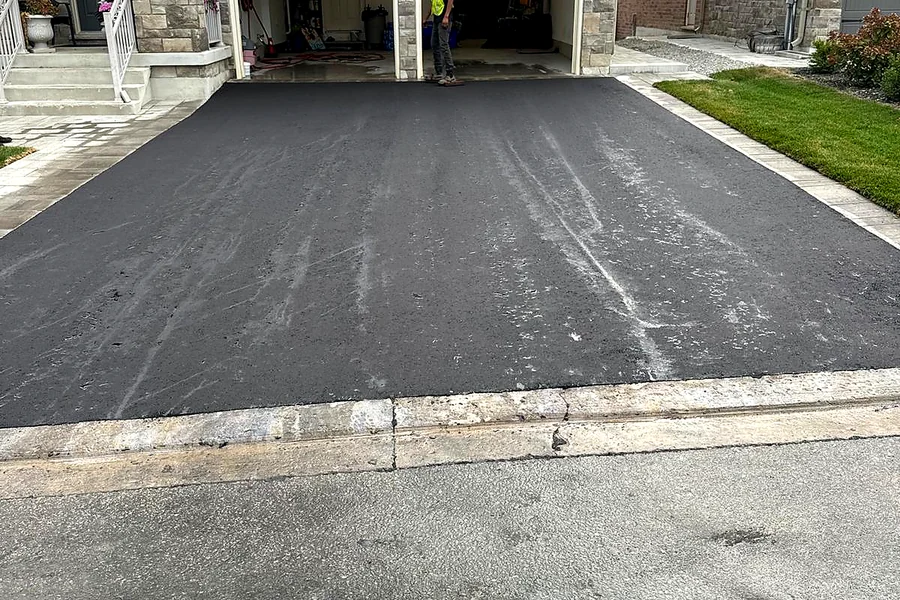
Asphalt is less directly affected — bitumen is not chemically attacked by chloride. The problem is indirect: salt keeps water liquid and mobile in cracks and at the surface, so more of it works into the base, where freeze-thaw does the structural damage.
Concrete pavers sit between the two. They are denser and better cured than most poured concrete, so they resist scaling well, but heavy repeated salt over many years still takes a toll on the surface finish.
The alternatives, honestly
Sand provides traction without chemistry. It does not melt anything, it needs sweeping up in spring, and it must not be used on permeable pavers because it clogs the joints.
Calcium chloride works at much lower temperatures than rock salt, so less product achieves more. More expensive, gentler in total load.
Magnesium chloride is similar and generally kinder to vegetation along the edges.
Urea and CMA are the gentlest on surfaces and the most expensive, generally reserved for new concrete in its first winter.
What matters more than the product
Clearing snow before it gets compacted. Compacted snow becomes ice, and ice needs far more de-icer than loose snow ever would.
Using less, more often, beats using a lot once. Most people apply several times what is needed.
And sweeping up residual sand and salt in spring, so it is not sitting on the surface through the wet months.
A driveway cleared promptly with modest de-icer use will outlast one that gets a heavy dose after every storm, whatever product is in the bag.
Questions
Is salt safe on a new driveway?
On new asphalt, wait until it has cured through its first season. On new concrete, avoid salt entirely for the first winter.
Does salt damage interlock?
Far less than poured concrete, but heavy repeated use over years affects the surface finish. Sand or a chloride alternative is gentler.
What about my lawn and plants?
Chloride runoff damages soil and vegetation along the edges. Magnesium chloride is generally the gentlest of the effective options.
Related
Keep reading
Free estimate
Questions about your own driveway?
We measure on site, probe the base and quote in writing within 48 hours.
Request my estimate