
Design
Patterns are structural, not just decorative.
Choosing a paver pattern feels like an aesthetic decision, and for a patio it largely is. For a driveway it is an engineering one — the pattern determines how load moves through the surface, and getting it wrong shows up as rutting within a few years.
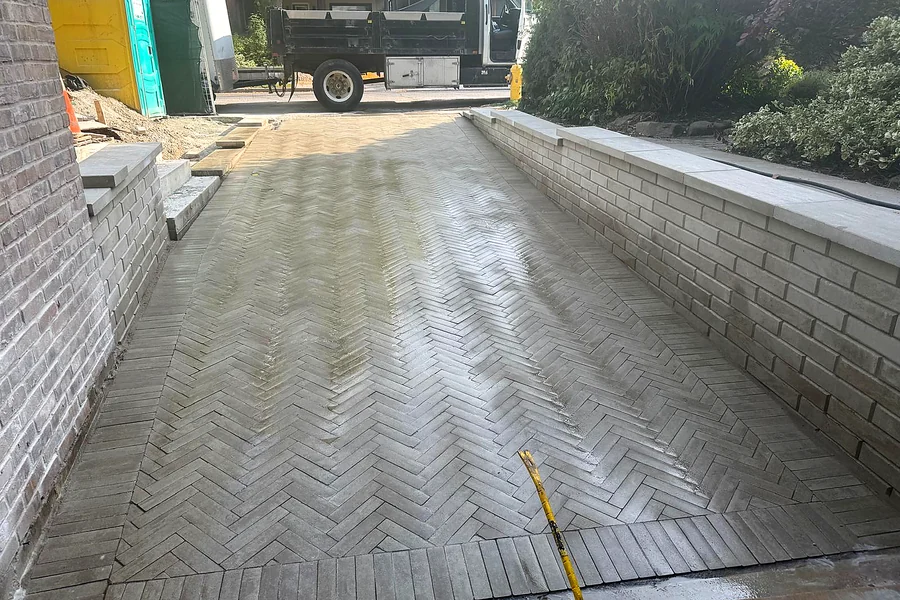
Herringbone — the one for vehicles
Pavers laid at 45° or 90° to each other in an interlocking zigzag. No continuous joint lines run in any direction, which means load applied to one paver is transferred sideways into its neighbours rather than pushing straight down.
That is what makes it the correct choice under vehicles. It resists the horizontal forces of braking, turning and accelerating that pull other patterns apart.
It costs more to install because every paver along the perimeter has to be cut at an angle. That extra labour is the price of a driveway that does not rut.
Running bond and stack bond — for foot traffic
Running bond offsets each row by half a paver, like brickwork. Simple, fast, attractive, and it has continuous joint lines in one direction — which is where movement concentrates under vehicle load.
Stack bond aligns everything in a grid. Very clean and contemporary, and structurally the weakest, with continuous joints in both directions.
Both are perfectly good choices for patios and walkways. Neither belongs under a car.
Random ashlar and large format
Random ashlar mixes several paver sizes into an irregular layout that reads as natural stone. It avoids continuous joint lines, which makes it more forgiving than running bond, and it disguises minor colour variation between pallets — useful on large areas.
Large format units make a small space read as bigger and give fewer joints to maintain. Under vehicles they need careful base work because there is less interlock between units to distribute load.
The border is not optional
Whatever the field pattern, the perimeter gets a soldier course — a border row running the long way around the edge.
It frames the work visually, it gives the edge restraint something continuous to lock against, and it contains the field pattern so the cut pavers at the perimeter are not the ones taking edge load.
A contrasting colour on the border is the single cheapest way to make a paver surface look designed rather than installed.
Questions
Can I use running bond on a driveway?
You can, and it will develop rutting along the continuous joint lines sooner than herringbone would. For vehicles, herringbone is the right answer.
Does the pattern affect cost?
Yes. Herringbone and random ashlar involve more cutting and more labour than running bond. The difference is meaningful on a large area.
Which pattern hides dirt best?
Multi-size layouts with mixed tones hide staining and colour variation better than a single-size single-colour field.
Related
Keep reading
Free estimate
Questions about your own driveway?
We measure on site, probe the base and quote in writing within 48 hours.
Request my estimate