
Materials
HL-3, HL-8, and why your driveway needs both.
If your quote says 'asphalt' with one thickness, it is describing half a driveway. Residential paving in Ontario uses two different mixes doing two different jobs, and the difference between them is why properly built driveways do not crack along a seam.
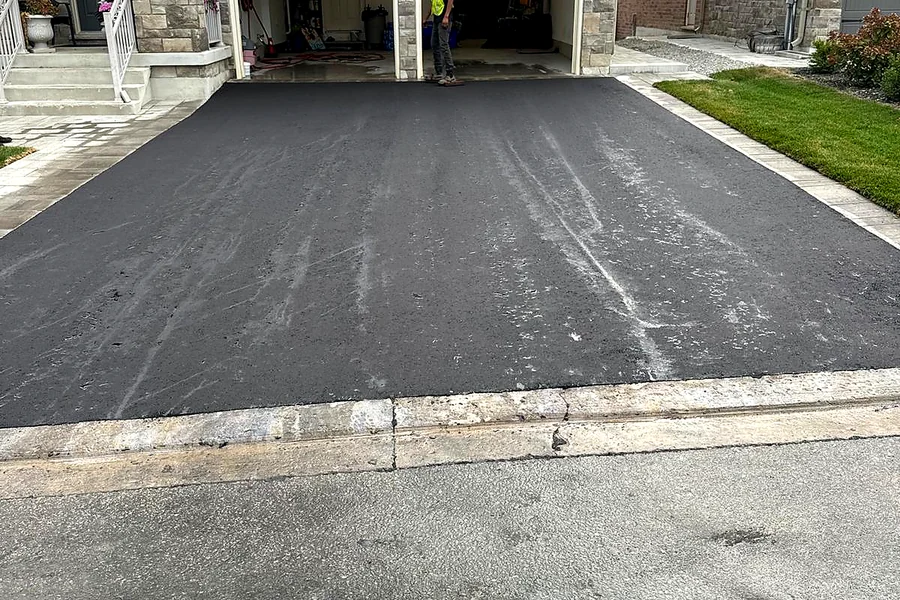
Two mixes, two jobs
HL-8 is the base course. Coarser aggregate, more structural, laid directly on the compacted granular base at around 50 mm. Its job is to carry load and bridge minor movement in the base beneath it.
HL-3 is the surface course. Finer aggregate, denser, smoother, laid on top at around 40 mm. Its job is to be the wearing surface — to shed water, resist weather, and look like a driveway.
Using only HL-3 gives you a smooth surface with less structural capacity. Using only HL-8 gives you a coarse, open surface that lets water through. Neither alone is right.
Why two lifts rather than one thick pour
Ninety millimetres of asphalt in a single pour cools unevenly — the top surface hardens while the bottom is still hot, which prevents proper compaction through the full depth and locks in stress.
The result is a driveway that develops a longitudinal crack along the middle within a few seasons, because that is where the differential cooling concentrated.
Two lifts, each compacted while workable, produce consistent density top to bottom. It is the same amount of material and a slightly longer day, and it is the difference between a driveway that cracks at year four and one that does not.
What to look for on a quote
Two numbers, not one. '50 mm base course, 40 mm surface course' or equivalent.
If a quote says '90 mm of asphalt' without splitting it, ask whether it is going in one lift or two. The answer tells you a great deal about how the rest of the job will be done.
Commercial work uses heavier mixes and greater thicknesses again, particularly in drive aisles where trucks track the same wheel paths thousands of times a year.
Questions
Is thicker asphalt better?
Up to a point, and far less than people assume. Base depth and compaction matter considerably more. Thick asphalt on a poor base still fails.
Can I just get the surface course?
Only as an overlay on an existing sound structure. A new driveway needs both courses.
What is the total asphalt thickness on a residential driveway?
Around 90 mm in two lifts is the standard we build to. Commercial and heavy-use surfaces go thicker.
Related
Keep reading
Free estimate
Questions about your own driveway?
We measure on site, probe the base and quote in writing within 48 hours.
Request my estimate